
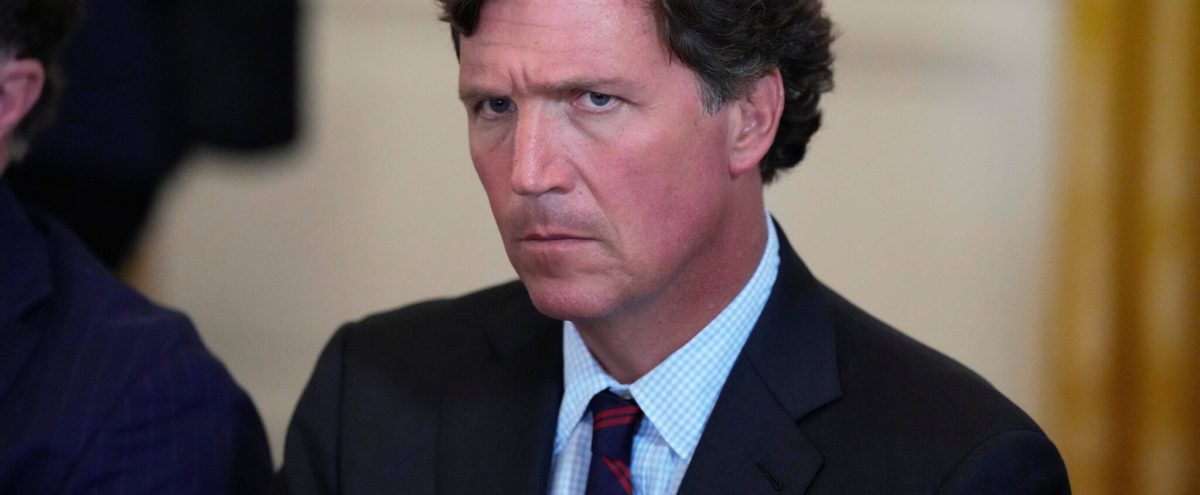
The public feud between Donald Trump and Tucker Carlson has reached a new level—and this time, it’s personal.
After Trump blasted Carlson as a “low IQ person” and suggested he should see a “good psychiatrist,” Carlson didn’t back down. Instead, he responded with a mix of criticism, speculation, and a tone that suggests this fight is far from over.
Carlson’s Surprising Response
Rather than matching Trump’s insults directly, Carlson took a different approach.
In his response, he suggested Trump deserves “grace,” but added a controversial twist—raising the possibility that Trump could be under outside pressure, even hinting at the idea of blackmail tied to foreign influence.
That comment alone shifts the feud from political disagreement into something much more serious.
This is no longer just about policy differences. It’s about motives, influence, and control.
What Started the Feud
The clash didn’t come out of nowhere.
Carlson has been openly critical of Trump’s stance on the escalating conflict with Iran, warning that the U.S. could be heading toward a dangerous and unnecessary war.
Trump fired back aggressively, accusing Carlson and other conservative voices of undermining him and labeling them “low IQs” seeking attention.
That exchange exposed a deeper divide inside the political right—one that’s becoming harder to ignore.
From Allies to Adversaries
What makes this feud especially significant is the history.
Carlson was once one of Trump’s most influential media allies. His platform helped shape political narratives and rally support across a large audience.
Now, that relationship has fractured.
The disagreement over foreign policy—particularly the Iran conflict—has turned former allies into outspoken critics. And the rhetoric on both sides is escalating fast.
A Movement Divided
This isn’t just a personal dispute. It’s a signal of something bigger.
The conservative movement itself appears to be splitting into factions:
One side supports a more aggressive foreign policy approach.
The other is pushing back, warning against deeper military involvement.
Carlson has positioned himself firmly in that second group, while Trump is doubling down on strength and escalation.
That divide is now playing out in public—and it’s getting louder.
The Tone Is Getting More Extreme
What stands out most in this exchange is the tone.
Trump’s comments weren’t just political—they were personal attacks. Carlson’s response, while less direct, introduced serious accusations and implications.
This kind of escalation changes the nature of the conversation.
It moves from debate into confrontation. And once it reaches that level, it becomes harder to walk back.
What This Means for You
This feud matters because it reflects a shift in how political influence works.
Media figures like Carlson are no longer just commentators—they are power players with massive audiences.
When those figures break from political leaders, it can reshape public opinion quickly.
And when the disagreement turns personal, it can deepen divisions even further.
Final Notes
The clash between Donald Trump and Tucker Carlson is no longer just a disagreement—it’s a full-scale rupture.
On one side, a president pushing forward.
On the other, a former ally questioning the direction entirely.
And in between, a movement trying to decide which path it will follow.
One thing is clear: this story isn’t cooling down anytime soon.





Add comment